Ask a sign maker what a sign costs and the honest first answer is “it depends”. That is true, but it is not much help when you are setting a budget for a new shop, office or branch. This guide gives published price ranges from sign makers in the UK and the US, explains the five things that move a quote up or down, and lists the questions to ask so that the quotes you collect can be compared fairly. When you are ready to talk to suppliers, our sign companies and illuminated signs pages list makers whose details we have checked on their own websites.
Typical price ranges
Few sign makers publish prices, because every building is different. The ranges below come from two that do: Pioneer Signs, a Birmingham sign maker that publishes supplied-and-fitted ranges for England and Wales, and ChannelLetter.com, a US factory-direct maker of channel letter signs. Both describe their figures as indicative, not quotes.
| Sign type | Typical range |
|---|---|
| Vinyl lettering applied to an existing fascia | £150 to £400 |
| Non-illuminated tray sign, 3 to 5 m frontage | £600 to £1,500 |
| Non-illuminated tray with flat-cut letters | £1,200 to £2,500 |
| Illuminated tray with an opal acrylic face | £1,500 to £3,500 |
| Face-lit built-up letters, 3 to 5 m frontage | £2,500 to £6,000 |
| Halo-lit built-up letters | £3,500 to £8,000 or more |
| Projecting or hanging sign | £350 to £1,200 |
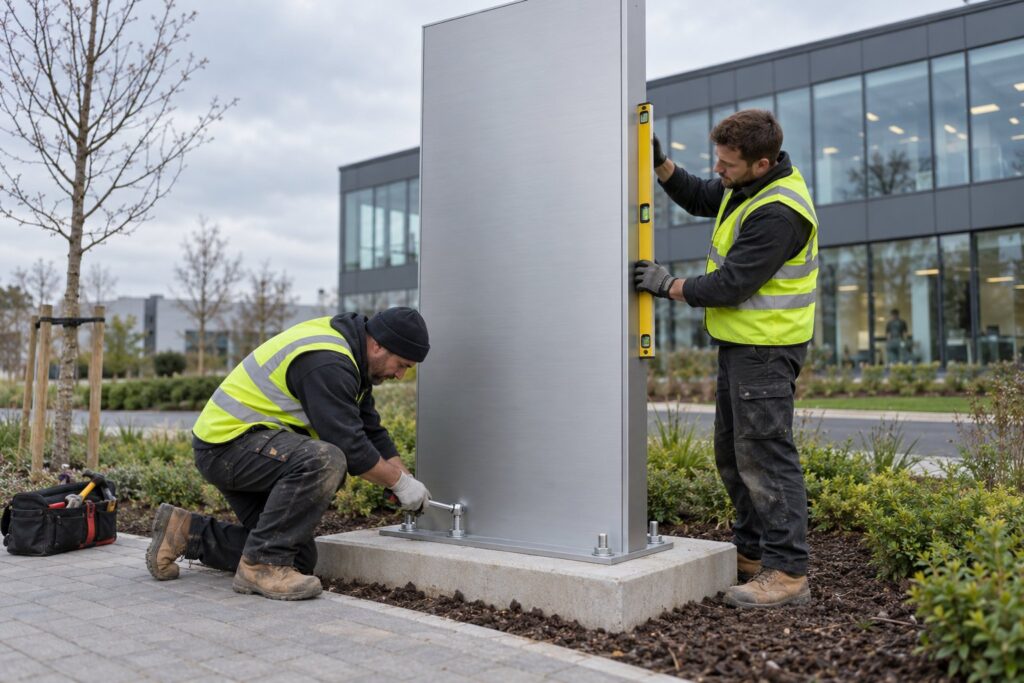
| Freestanding totem or monolith, including foundations | £3,000 to £12,000 |
| Sign type | Typical range |
|---|---|
| Face-lit channel letters | $800 to $2,500 |
| Back-lit (halo-lit) channel letters | $1,000 to $3,000 |
| Front and back-lit letters | $1,200 to $3,500 |
| RGB colour-changing letters | $1,500 to $4,000 |
| Metal letters, non-illuminated | $500 to $1,800 |
The two sets are not directly comparable. The UK figures include fitting, while the US guide is written by a manufacturer that sells direct, and it says the same sign can cost 30 to 50% more when bought through a local sign shop. Treat both as a starting point for a conversation, not as a price list.
What moves the price
Sign makers who publish cost guidance agree on the main drivers. In rough order of impact:
1. Illumination
Pioneer Signs says lighting roughly doubles the cost of the same sign, because it adds fabrication, wiring, testing and an electrical supply. The choice is between an internally lit tray or lightbox, individually lit letters (face-lit or halo-lit), or external lighting such as a trough light over a plain tray, which is usually the cheapest way to get a lit frontage. If you want lit letters, our channel letters and built-up letters page lists makers, including trade-only manufacturers that supply other sign companies.
2. How the letters are made
Vinyl on a flat panel is cheapest. Flat-cut acrylic or metal letters fixed to the panel add depth for a modest step up. Individually fabricated built-up letters cost the most; Pioneer puts the gap between vinyl and built-up letters on the same frontage at four to five times.
3. Size
Size matters less than most buyers expect. Survey, drawings, delivery and access cost roughly the same whether a fascia is three metres or six, so doubling the width does not double the price.
4. Access and installation
A sign that can be fitted from a ladder is cheap to install. One that needs a powered access platform, a pavement licence or an out-of-hours slot in a pedestrian street can add more than the sign itself. Ask whether access equipment is included in a quote, and who arranges any council licence.
5. Permission and permits
In England, the Planning Portal says you may need advertisement consent for a sign larger than 0.3 square metres, or any size if it is illuminated, and decisions should be made within eight weeks. In US cities a permit is common: Chicago, for example, charges a $200 zoning review fee for an on-premise sign plus a building review fee based on the sign’s area, and electrical work must be done by a registered electrical contractor. Our guide to sign permits and advertisement consent covers this in more detail.
Costs buyers often miss
- Removal and making good. Taking down an old sign and repairing the wall behind it is a separate job on many quotes.
- Electrical supply. Pioneer’s ranges exclude bringing power to the sign. If there is no supply at the fascia, an electrician will need to run one.
- Design. A visual for a simple fascia is often included; redrawing a logo or designing a scheme across several sites is usually charged separately.
- Surveys outside the local area. Some makers charge travel for smaller jobs further away.
- Window manifestation. Safety bands on glazed shopfronts are often done on the same visit; Pioneer lists them at £150 to £400.
Ways to spend less without cutting corners
The same published guidance suggests several practical savings. If the existing tray is sound, a new face and new lettering costs a fraction of a new sign. An old fluorescent lightbox can often be retrofitted with LEDs rather than replaced. Flat-cut letters on stand-off fixings read as solid at street distance and cost far less than fabricated letters. And bundling the fascia, window graphics and any vehicle lettering into one visit is cheaper than three separate call-outs.
For multi-site rollouts, national sign companies and brand implementation firms can survey, manufacture and install across a whole estate, and some trade-only manufacturers supply local sign companies at wholesale prices. Our trade and wholesale sign manufacturers page lists the latter.
Questions to ask before you compare quotes
- Is the price supplied and fitted, and does it include VAT or local sales tax?
- Does it include survey, design, removal of the old sign, access equipment and making good?
- What materials are specified: aluminium composite, acrylic, stainless steel, and which LED modules and power supplies?
- Who applies for advertisement consent or a sign permit, and is the fee included?
- Who provides the electrical connection, and is the installer qualified to do it?
- What warranty covers the sign and the lighting, and what does annual maintenance cost?
- How long from approval of the drawing to installation?
Two quotes that look far apart are often for different jobs. Asking every supplier to price the same specification, with the same inclusions, is the quickest way to see who offers real value.
Finding a sign maker
Every supplier in our directory has been checked on its own website, with the date of the check shown on its listing. Start with sign companies and sign makers for complete design-to-install service, shop front and fascia signs for high-street premises, or pylon, monument and totem signs for freestanding signs. Makers such as Greens Signmakers, Harrisons Signs, Image National Signs and Allen Sign Company all list the sign types covered here.
Sources
- Pioneer Signs, What does a shop sign cost? (UK ranges, supplied and fitted, excluding VAT; revised September 2026).
- ChannelLetter.com, Channel Letter Sign Cost: 2026 Pricing Guide.
- Planning Portal, Adverts and signs and Advertisement consent.
- City of Chicago Department of Buildings, Sign permits.
- Search demand: Signage Resource keyword research (Google Ads data via DataForSEO), October 2026.