
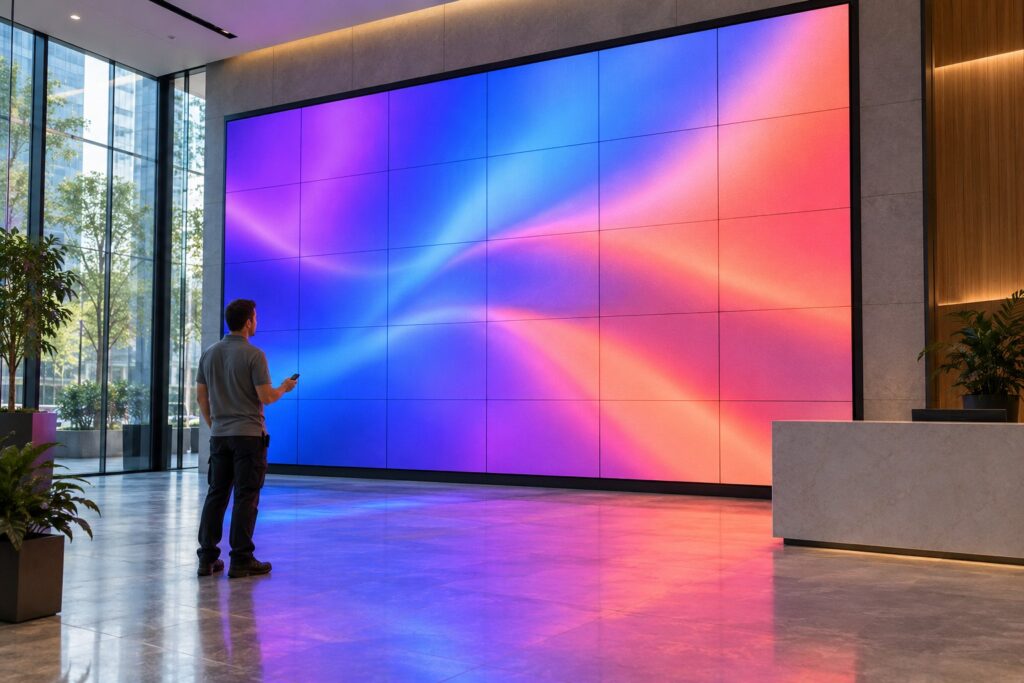
Digital signage means screens that show content managed from a computer or the cloud: menus, promotions, wayfinding, staff notices or live information. Buyers usually want to know two things: what it costs, and what they are actually paying for. This guide breaks the cost into its parts (software, players, screens, installation and content), gives published prices where suppliers show them, and covers LED video walls, which are priced very differently. Providers are listed on our digital signage and LED displays page.
What you are paying for
A digital signage system has five parts, and quotes differ mainly in which of them they include:
- Content management software, usually a cloud subscription charged per screen.
- A media player behind or inside each screen. Some screens have a built-in player; some software vendors supply their own player hardware.
- Displays: commercial LCD screens for most indoor uses, or LED panels for large walls and outdoor signs.
- Installation: mounts, cabling, power and network connection.
- Content: templates you fill in yourself, or designed content from the supplier or an agency.
Software: the running cost
Most cloud platforms charge a monthly or annual fee per screen. Yodeck, a US-based platform, publishes its prices: free for a single screen, then $8 (Basic), $12 (Premium) and $16 (Enterprise) per screen per month, with equivalent prices shown in pounds, euros and Canadian and Australian dollars. Its pricing page also offers a free player and a free lifetime warranty on the player under its stated terms.
Rise Vision, based in Toronto, prices per display per year, with annual, three-year and five-year terms, and says yearly billing saves 9% on average. Other vendors in our directory, including OptiSigns, Visix, Mvix and Navori, publish plans or ask for a quote depending on scale. Mvix, for example, describes its players and software as a one-time cost without subscriptions.
| Plan | Price per screen per month |
|---|---|
| Free | $0 (one screen) |
| Basic | $8 (£7) |
| Premium | $12 (£10) |
| Enterprise | $16 (£13) |
When comparing software, look past the headline price at what each tier includes: the number of users, scheduling, integrations with other systems, offline playback, security controls and support hours.
Screens and players: the upfront cost
Screens are usually the largest upfront cost. Ask any supplier which screens it proposes, whether they are rated for the daily running hours you need, what brightness they offer (important in sunny windows), and what the warranty covers for commercial use. If the software vendor bundles a player, check what happens to it if you leave the platform.
LED video walls
Large walls in atriums, shopfronts, venues and outdoor sites are usually made from LED panels, priced per square metre. The main cost driver is pixel pitch, the distance between LEDs: the finer the pitch, the closer people can stand and the higher the price. Dynamo LED Displays, a UK supplier, publishes median quoted prices for 2026:
| Pixel pitch | Median price per m² | Typical use |
|---|---|---|
| Fine pitch 1.5 to 1.9 mm | £6,580 (range £1,570 to £8,140) | Boardrooms, receptions, close viewing |
| Mid pitch 2.5 to 2.6 mm | £4,540 (range £1,690 to £6,190) | Atriums, retail, showrooms |
| Coarse pitch 3.9 to 6.25 mm | £3,680 (range £1,490 to £4,830) | Large indoor, shopfront, outdoor |
On those figures, Dynamo says UK budgets run from about £8,000 for a small entry-level indoor wall to more than £200,000 for a large fine-pitch installation, and works through an example of a 3 m by 2 m P2.5 indoor wall at about £31,000 to £32,000 installed. It lists installation at £150 per square metre with a £1,000 minimum, and explains that small walls cost more per square metre because the processor, installation minimum and survey are fixed costs.
Manufacturers and suppliers of LED displays in our directory include Watchfire Signs in the US for LED signs and video displays, and Media Resources, VueTronic and Genoptic in Canada.
Menu boards and kiosks
For restaurants, specialists such as WAND Digital, Delphi Display Systems and Coates Group combine menu software, displays, drive-thru equipment and content design, usually sold as packages or by quote. Self-service kiosks are a separate purchase with their own hardware, payment and software costs; makers include KIOSK Information Systems, Olea Kiosks and Frank Mayer and Associates.
Budgeting for the whole life of a screen
The cheapest system to buy is not always the cheapest to run. A simple way to compare offers is to add up the cost per screen over three or five years: software fees for the whole period, the player and screen, mounts and installation, and any support or content service. A free or low-cost software tier can make sense for a single screen in a café or reception, while a network of screens across many sites usually needs the user permissions, scheduling, reporting and support that come with higher tiers.
Also plan who will keep the content fresh. Screens showing the same slide for months lose attention quickly, so budget staff time or a content service from the start. Several platforms offer templates and integrations (Yodeck, for example, advertises more than 800 templates and over 140 app integrations) that cut the time needed for routine updates such as menus, social feeds and notices.
Questions to ask before you buy
- What is the total cost per screen over three years, including software, player, screen, installation and support?
- Is the software price per screen, per location or per user, and what happens to the price as you add screens?
- Which player and display models are proposed, and what are their warranties?
- Will content keep playing if the internet connection drops?
- Who creates content, and what does a change cost?
- For LED walls: what pixel pitch, what viewing distance, and is the processor, installation and delivery included?
Sources
- Yodeck, pricing page, checked 26 October 2026.
- Rise Vision, pricing page, checked 26 October 2026.
- Dynamo LED Displays, LED display screen price UK.
- Mvix, mvix.com, and other supplier websites linked above, checked 26 October 2026.
- Search demand: Signage Resource keyword research (Google Ads data via DataForSEO), October 2026.