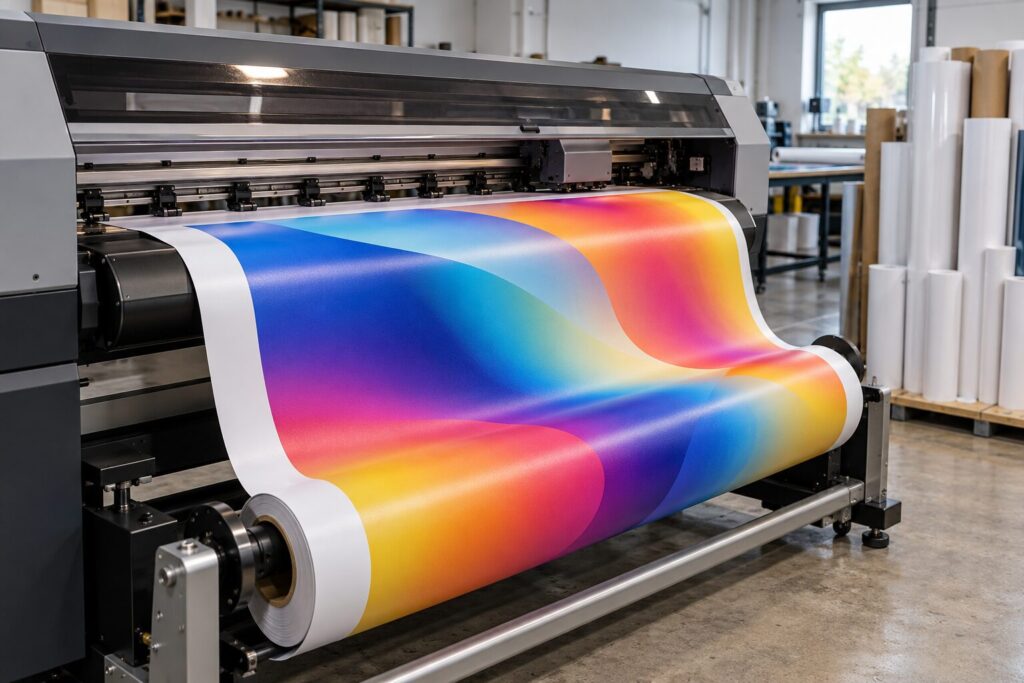
Large format printing is printing on wider media than an ordinary office or commercial press can handle, used for banners, posters, signs, vehicle wraps, wall and window graphics, trade show displays and architectural drawings. This guide explains what large format printing is, how it differs from standard printing, the main ink technologies, roll-to-roll and flatbed machines, common applications and finishing, and what to ask a large format print supplier.
What is large format printing?
HP defines large format printing, also called wide format printing, as printing that uses large equipment to produce images on paper or other media more than 24 inches wide, compared with around 11 inches for standard prints. Size is not the only difference. HP notes that large format prints can be made on many different media types, and that the printers are faster and more versatile than standard printers. HP lists banners, vehicle wraps, posters, displays, home decor and detailed drawings among the uses.
So what is wide format printing compared with large format? In everyday use the two terms mean the same thing. Manufacturers describe their machines by maximum print width. Mimaki’s current range, for example, runs from 0.6 meter desktop models to 3.2 meter machines, and Roland DG’s TrueVis XG-640 is a 64-inch printer/cutter.
How large format printing works
Most large format printers are inkjets. HP describes the process in four stages: preparing the file at the right resolution, color profile and scale; choosing and loading media that suits the job; printing, as the carriage moves the print heads across the material while it advances through the printer; and drying or curing after printing. Most sign and display work then goes through finishing, such as laminating, cutting or mounting, before it is installed.
HP recommends at least 300 DPI for detailed prints and stresses file preparation: set the resolution and color mode, set the image to scale, embed fonts and linked files and do a final check before sending the job. A print shop will usually tell you its preferred file format and bleed.
Large format printing ink technologies
The ink decides which materials a printer can handle, how durable the print is and whether it can go outdoors. Mimaki groups its own wide format printers into solvent, UV, latex, textile, sublimation transfer and DTF machines, which covers the main types you will see.
| Technology | How the ink sets | Typical uses (from manufacturer descriptions) |
|---|---|---|
| Eco-solvent and solvent | Solvent carries the pigment into coated media such as vinyl | Signs, banners, vehicle wraps, backlit displays, window and floor graphics, wallcoverings (Roland DG) |
| Latex | Water-based ink; heat and airflow evaporate the water and the latex forms a protective layer | Displays, vehicle wraps, signage, and rigid boards on hybrid models (HP) |
| UV-curable | Ink is cured by ultraviolet light | Roll media and, on flatbed machines, rigid boards and objects (Mimaki range) |
| Textile and sublimation transfer | Dye or pigment ink printed onto fabric, or onto transfer paper and moved to fabric | Fabric graphics, soft signage and textiles (Mimaki range) |
| Water-based pigment | Aqueous pigment ink | Posters, proofs and indoor prints (Mimaki range) |
HP says each drop of its latex ink contains a liquid vehicle that is about 65% water, plus pigment and latex polymer particles, and that prints come out dry and ready to use. Roland DG argues that its eco-solvent printers offer productivity that latex and other printers cannot match. Each maker makes the case for its own technology, so judge them on samples of the jobs you actually need.
Roll-to-roll and flatbed printers
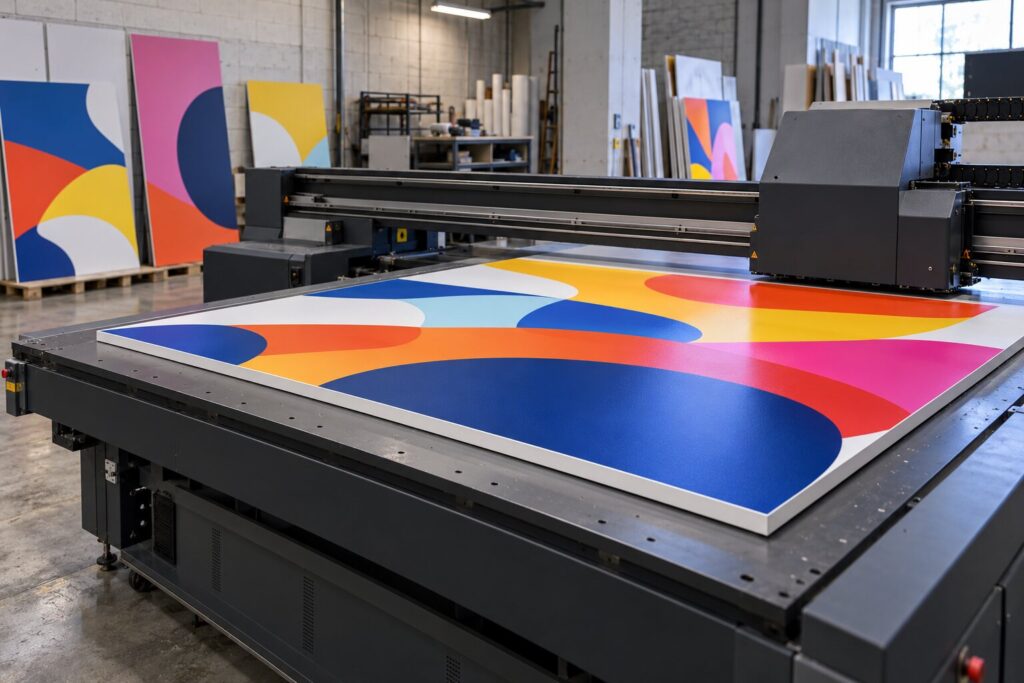
Roll-to-roll printers feed flexible media such as vinyl, banner material, paper and fabric from one roll and wind it onto another, and many sign shops use print-and-cut models that also contour cut stickers and decals. Flatbed printers hold the material on a flat table, which lets them print directly onto rigid boards such as aluminum composite and foam board, and in some cases onto objects. Hybrid machines handle both: HP’s Latex R530 prints boards and rolls up to 64 inches wide and media up to 2 inches thick. Our guide to rigid sign materials explains the boards most often printed this way.
Common large format printing applications
- Banners and posters for events, retail and construction sites
- Window, wall and floor graphics
- Vehicle wraps and fleet graphics
- Rigid sign panels, hoardings and point of sale displays
- Fabric graphics for trade show stands, backdrops and lightboxes
- Architectural drawings, blueprints and site signage, which HP lists among its customers’ main uses
Finishing large format prints
Finishing turns a print into a product. Common steps are laminating to protect the surface, contour or flatbed cutting, mounting onto boards, and hemming and eyelets for banners. Ask your supplier which finishing it does in house. Our directory lists suppliers of laminators and finishing equipment for shops that do their own.
Choosing a large format print supplier
Questions worth asking:
- Which ink technology will you use for this job, and how long will it last indoors or outdoors?
- What is the maximum width, and will large pieces need joins?
- Which file format, resolution and bleed do you need?
- Can you send a printed sample on the actual material?
- Do you laminate, cut, mount and install in house?
Browse large format printing companies in our directory, or trade printers if you are a sign shop buying print wholesale. If you are buying a machine, see our wide format printer suppliers.
Sources
- HP, The Large Format Printing Process: How Does Large Format Printing Work?, April 15, 2026.
- HP, HP Latex Technology and HP Latex printers.
- Roland DGA, Large Format Eco-Solvent Printers and Printer/Cutters.
- Mimaki, Inkjet printers product range.