
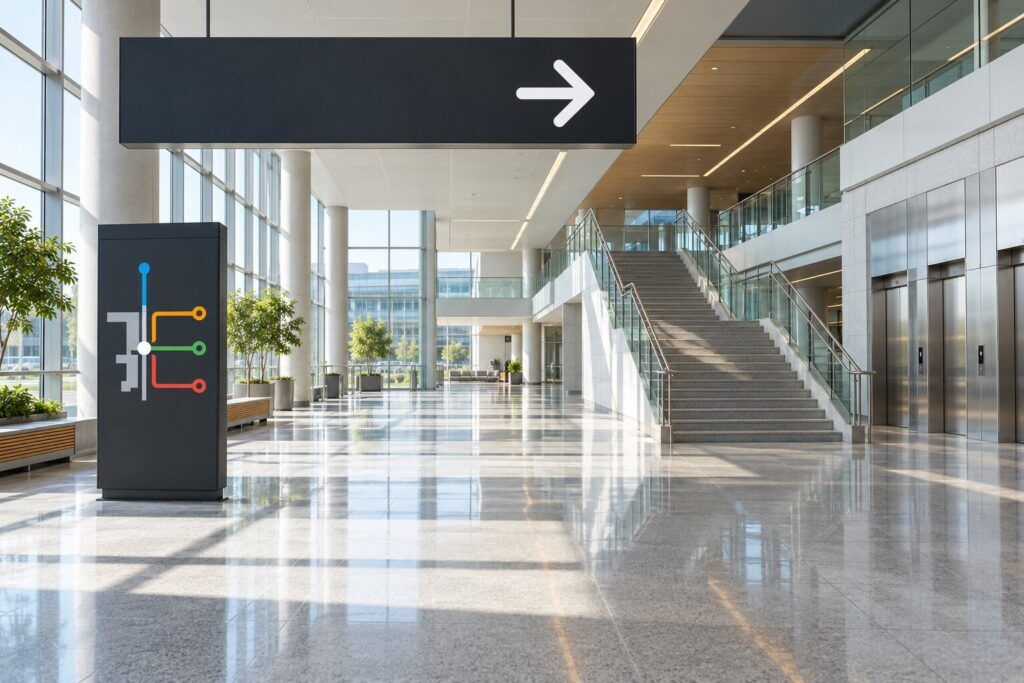
Wayfinding design is the planning and design of the signs, maps and other information that help people find their way through a place: a hospital, campus, airport, office, park or city center. Done well, people barely notice it. Done badly, it makes visitors anxious, late and frustrated. This guide explains what wayfinding is, how a wayfinding system is designed from first survey to installation, the sign types involved, how accessibility and digital wayfinding fit in, and what to ask a wayfinding designer or sign company before you hire one.
What is wayfinding?
Joseph Mackereth, a wayfinding and environmental designer writing for the Society for Experiential Graphic Design (SEGD), describes wayfinding as an interdisciplinary approach to solving navigational problems. It grew out of the mid-20th century, when designers working on large, complex buildings and cities combined information design, graphic design and industrial design into one discipline. Information design defines the problem and tests solutions, graphic design handles typography and icons, and industrial design deals with the physical signs and how they fit into the built environment.
Wayfinding signage is only one part of it. Mackereth points out that people rely on architecture first when looking for navigational clues, using form, layout, size, color and light, and turn to signs when the architecture does not tell them enough. So the best wayfinding systems work with the building rather than covering it in signs, and they are planned as early in a project as possible.
What makes wayfinding design effective
An evaluation framework published through SEGD by researchers at York University quotes Arthur and Passini’s book People, Signs and Architecture on the qualities that make visual wayfinding aids useful:
- message clarity
- coordination of information
- adequate information at decision points
- adequate lighting
- legibility
- accuracy and reliability of information
- no physical obstructions
Mackereth adds two principles that run through good wayfinding design. The first is simplicity: in stressful places such as hospitals and airports, unnecessary design elements should go, because simple messages are easier to understand and remember. The second is progressive disclosure, giving people the right information at the right time. Major decisions such as entrances and parking come first, then more specific destinations as people move along a route, with information placed at each decision point.
The wayfinding design process
Wayfinding projects can take months or years. The stages below follow the process Mackereth describes, from discovery through information design to the physical system, with evaluation at the end, which the York University researchers argue is often skipped.
1. Discovery
Mackereth says it takes time, planning and a lot of walking to find the patterns in a space, helped by architectural drawings or maps for a bird’s-eye view. Talking with stakeholders and the people who use the building every day is, in his words, an invaluable part of the discovery phase that should never be overlooked.
2. User groups and priorities
Most places serve several kinds of visitor, and they need different directions. Mackereth suggests grouping users by their wayfinding needs and ranking them in a hierarchy, so the main users come first. His example is a hospital, where patients take priority over pharmacy staff.
3. Information design
This is where the designer catalogs every destination and decision point and writes the message for each one. It is worth asking for this as a written message schedule, listing each sign’s location, type and wording, so you can review it before anything is made. Mackereth stresses that the physical design should only start after, or near the end of, this stage, because the information decides things like the letter size needed at each viewing distance, which then drives the build and materials.
4. Sign family and fabrication
The physical system is made up of a family of components. Mackereth lists identification and directional signs, maps, physical markers, graphic representations and consistent naming. Prototypes help check legibility, size and position before full production, which is the first type of evaluation the York University paper describes.
5. Installation and evaluation
The York University researchers argue that observing how people actually use signs after a building opens is essential for making adjustments, because designers often start with little more than floor plans. They note that this post-occupancy evaluation is often left out of the budget, so it is worth asking for it at the start.
Types of wayfinding signs
| Sign type | What it does | Examples |
|---|---|---|
| Identification | Names a place or confirms arrival | Building names, room numbers and names, restroom signs |
| Directional | Points the way to destinations | Arrows at junctions, hanging corridor signs, totems |
| Orientation | Shows where you are and the layout | Maps and directories at entrances and decision points |
| Informational | Gives information about a space | Opening hours, rules, instructions |
Accessibility in wayfinding systems
In the United States, signs that identify permanent rooms and spaces must meet the tactile and visual requirements of the 2010 ADA Standards, while directional and informational signs must meet the visual requirements. That affects letter heights, contrast, finish and mounting positions across the whole system, so it should be built into the design from the start rather than added at the end. Our guide to ADA signage requirements covers the specifications, and our directory lists ADA and braille sign makers. Other countries have their own accessibility codes.
Digital wayfinding
Mackereth notes that wayfinding components can be integrated into a space physically or digitally, and that digital screens are now part of how people navigate many public buildings. Interactive kiosks, digital directories and screens can change messages by time of day or for events, which static signs cannot. They still need the same information design underneath, and they add power, content management and maintenance to the project. See our digital signage suppliers and our guide to digital signage costs.
Hiring a wayfinding designer or sign company
Some projects use a specialist wayfinding consultant for planning and design and a separate fabricator to build and install the signs. Others use a design-and-build sign company that does both. Questions worth asking either:
- How will you carry out discovery, and will you talk to our visitors and staff?
- Will we get a message schedule we can review before anything is made?
- How will the system meet ADA or local accessibility requirements?
- Will you prototype key signs on site before full production?
- Is post-occupancy evaluation included, and what happens if it shows problems?
Our directory lists wayfinding signage companies, architectural signage makers and environmental graphics studios, with where each one works and what it makes.
Sources
- Joseph Mackereth, Society for Experiential Graphic Design, Wayfinding Is Where Place Meets Information Design.
- Sandra Gabriele, Anna-Lena Theus, Daniella Briotto Faustino and Bruce Tsuji, York University, via SEGD, A Framework for Evaluating Wayfinding Systems.
- U.S. Access Board, Guide to the ADA Accessibility Standards, Chapter 7: Signs.